Cisco
Company Overview
Cisco Systems is the worldwide leader in IT and networking. During this period (2012–2016), Cisco was navigating one of the most significant transitions in its history: the shift from purely hardware-centric networking to Software-Defined Networking (SDN) and the convergence of compute, network, and storage.
Company Transformation
| Timeline | Entity | Logo |
|---|---|---|
| 2012–2013 | Cisco (Classic) |  |
| 2013–2016 | Cisco (Modern) |  |
Company Profile
- Industry: Networking, Telecommunications, Cloud Infrastructure
- Tenure Period: 2012 – June 2016
- Context: The era of Cisco UCS (Unified Computing System), the birth of ACI (Application Centric Infrastructure), and the integration of networking into the cloud stack.
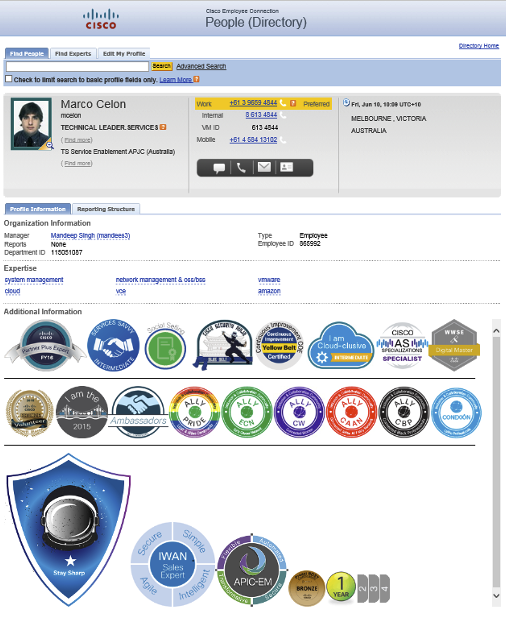
Internal Profile: Technical Leader Services, APJC Region (Australia)

Business Card: Technical Leader Services, Cisco Australia
The Technology Shift: From Hardware to Software
Joining Cisco after my tenure at IBM marked a distinct shift. I was brought in specifically to support the company’s aggressive push toward the software world—a strategic pivot for a giant whose identity was forged in proprietary hardware. This period (2012–2016) coincided with the transition from the John Chambers era to the Chuck Robbins era, symbolizing the move from “selling boxes” to “selling outcomes.”
Partner Support Service (PSS) and The Rise of Telemetry
One of the most significant initiatives I supported was the Partner Support Service (PSS). This offering utilized the Common Services Platform Collector (CSPC)—a “probe system” designed to automatically discover and report information about a customer’s Cisco installed base.
- The Goal: To move from reactive “break-fix” support (traditional SmartNet) to proactive intelligence, giving partners visibility into network health, security alerts (PSIRTs), and lifecycle status (EoL/EoS).
- The Tech: It was an early form of network telemetry. While the heavy appliance-based collectors of that era feel cumbersome compared to today’s lightweight agents and streaming telemetry, they were the pioneers of data-driven infrastructure operations.
The OpenStack, ACI, and “Intercloud” Era
Soon, the conversation expanded beyond support tools to active joint initiatives around OpenStack and infrastructure automation. This was a disruptive period. Cisco’s backbone was built on the battle-tested Cisco IOS and CLI management.
- The Conflict: The industry was pivoting to Software-Defined Networking (SDN). Cisco’s answer was Application Centric Infrastructure (ACI)—a policy-driven architecture that sought to bridge the gap between hardware performance and software flexibility.
- The Role: My work involved navigating this tension—helping customers understand how to integrate Cisco’s proprietary fabric with open standards like OpenStack. It was the era of the “Intercloud” vision, an ambitious (if ultimately transitional) attempt to federate private and public clouds.
Converged Infrastructure: The Peak of “Big Iron” (VCE)
Parallel to the software push was the hardware consolidation movement. I spent significant time on Converged Infrastructure, specifically the Vblock architecture from VCE (the Virtual Computing Environment coalition of Cisco, EMC, and VMware).
- The Concept: Pre-integrating best-of-breed hardware (Cisco UCS compute, Nexus networking, EMC storage, and VMware virtualization) into a single, massive, pre-validated rack.
- The Legacy: Achieving the VCE Certified Converged Infrastructure Associate (VCE-CIA) in May 2014 was a highlight. It represented the pinnacle of the “Pet” infrastructure era—massive, powerful, and carefully curated—just before the industry pivoted decisively to “Cattle” (commodity hardware), Hyperconvergence (HCI), and the public cloud.
Reflections on the Era
Looking back, this period was a masterclass in industry transformation.
- Gratitude: I am incredibly grateful for the opportunity to have worked inside the engine room of the internet during such a pivotal time.
- Obsolescence: Many of the specific technologies we championed—the heavy CSPC collectors, the early “Intercloud” connectors, and the rigid Vblock architectures—have been surpassed by cloud-native, API-first models.
- Legacy: However, the principles we fought for—automation, telemetry, and policy-based management—won. They simply evolved into the Kubernetes manifests and Prometheus metrics we use today.
Team and Colleagues
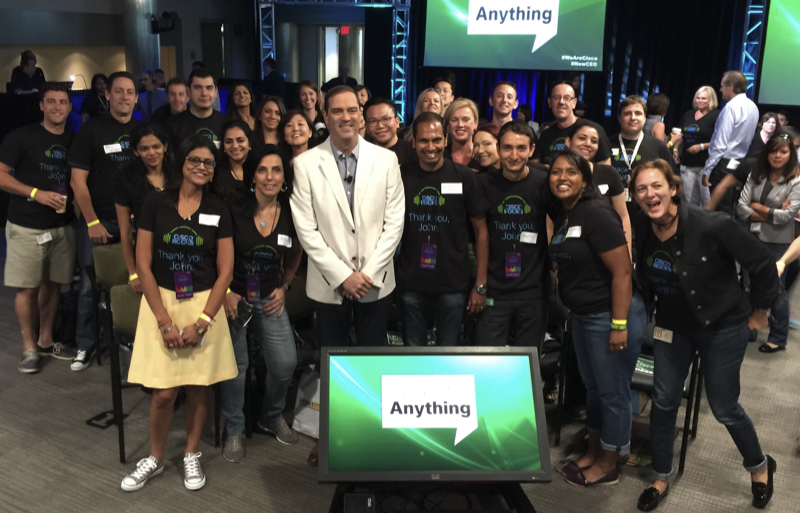
Cisco colleagues: Navigating the SDN transformation together.
Cisco tenure documentation during the Cloud-Native Transformation era.